
Please Choose Your Language


| Quantity: | |
|---|---|


HH70Z
HuaHe
Meta Description:
The HUAHE HH70Z offers ISUZU 6BG1 and Xichai CA6110 powertrains. Compare TCO, parts availability, and application fit to pick the right engine for your port, steel mill, or warehouse.
Here's the reality of heavy equipment procurement: the wrong engine choice doesn't just cost money — it costs uptime. Three-week parts delays, zero local service coverage, and fuel consumption 15% above projections turn a "good deal" into an operating liability within the first quarter.
When we designed the HH70Z, we started with a simple question: what if one forklift could serve both the distributor who needs global parts ubiquity and the fleet operator who needs cost-per-ton to stay below a hard ceiling?
The answer was two powertrains, one chassis. Below is a practical breakdown of which engine fits which operating reality — no marketing fluff, just procurement logic.
| Spec | ISUZU 6BG1 |
|---|---|
| Rated Power | 82 kW @ 2,200 rpm |
| Peak Torque | 411 N·m @ 1,600 rpm |
| Displacement | 6,494 cc |
| Cylinders | Inline 6 |
| Emissions | Stage III B |
You export to the Middle East, Southeast Asia, Africa, or South America. ISUZU's dealer and parts network in these regions is the gold standard. Dubai, Jakarta, Lagos, Santiago — service points are dense and parts lead times are measured in days, not weeks.
Your end customers specify engine brand in their tenders. In many emerging markets, buyer procurement documents explicitly list "ISUZU-powered" as a requirement. This isn't brand favoritism; it's supply-chain inertia. A fleet that already stocks ISUZU filters and gaskets isn't going to add a new engine platform for one forklift.
You don't want to manage spare parts logistics for your customer. The 6BG1 is one of the most widely deployed industrial engines globally. OEM and aftermarket parts are so abundant that a quick search on any B2B platform returns pages of suppliers — which means your customer can source independently without leaning on you for every consumable.
Peak torque at 1,600 rpm means the engine is at full muscle before the operator even reaches working RPM. In port container yards and steel coil warehouses — where a loaded forklift starts uphill, stops, reverses, and starts again hundreds of times per shift — early torque eliminates the hesitation that burns fuel and frays operator nerves.
The 6,494 cc displacement isn't about top speed; it's about duty-cycle headroom. A larger engine running at 70% of its capability wears slower than a smaller engine running at 90%. This is why a 10-year-old ISUZU-powered forklift with 15,000 hours still holds a bid at auction — the engine was never stressed to its ceiling.
| Spec | Xichai CA6110 |
|---|---|
| Rated Power | 85 kW @ 2,200 rpm |
| Peak Torque | 385 N·m @ 1,600 rpm |
| Displacement | 5,560 cc |
| Cylinders | Inline 6 |
| Emissions | Stage III A |
Your operations are within China, or export to markets with overland parts corridors (Central Asia, Russia, Mongolia). The CA6110 shares its platform with one of China's most widely deployed commercial truck engines — the FAW Jiefang series. Parts commonality is off the charts. Most prefecture-level cities in China can source critical spares same-day; the most remote county won't wait more than 48 hours.
Your customer lives and dies by equipment uptime — and they're in China. The Xichai aftermarket network isn't just a parts catalog; it's thousands of service stations. Engine warning light at 2 AM? A technician with the right diagnostic tools and a stocked van shows up by 8 AM. No air freight, no customs clearance, no three-way calls with an overseas distributor.
Your procurement budget is tight, but you refuse to compromise on build quality. Domestic supply chain economics — not cheaper materials — create the ~30% parts cost advantage. The same procurement budget buys you an extra set of consumable spares, or even a second unit, without touching quality.
The CA6110's turbocharger calibration is tuned for Chinese fuel quality and operating conditions. At moderate altitudes (Yunnan, Guizhou, Sichuan), the forced induction compensates for thinner air better than naturally aspirated competitors. In round-the-clock steel mill duty, those extra 3 kW translate to slightly lower diesel consumption per ton lifted — marginal in a single shift, material across a 5-year service life.
385 N·m sits comfortably above the 350–370 N·m range typical of competing domestically-engined 7-ton forklifts. Plenty for the job, without the parts premium of an import.
| Cost Line | ISUZU 6BG1 | Xichai CA6110 | Note |
|---|---|---|---|
| Machine Purchase Price | Baseline | Approx. -8% to -12% | Domestic engine lowers ex-factory cost |
| Annual Routine Maintenance | CNY 4,000–5,500 | CNY 3,000–4,000 | Domestic filters/oils cheaper |
| Core Spare Parts (avg.) | Baseline | -30% | Liners, pistons, injectors |
| Unplanned Downtime Risk | Low (export: 7–15 day parts wait) | Very Low (domestic: 24–48 hrs) | Location-dependent |
| 5-Year Resale Value | High (ISUZU brand premium) | Mid | ISUZU holds value in export markets |
| 5-Year Total Cost of Ownership | Baseline | Approx. -15% to -20% | Domestic use scenario |
| Your Operating Scenario | Recommended Engine | Why |
|---|---|---|
| Export to Middle East / Africa / SE Asia | ISUZU | Local parts network coverage |
| Domestic port or steel yard (China) | Xichai | Same-day parts; zero downtime cost |
| High-altitude operations (>2,000 m) | Xichai | Turbo calibration optimized for altitude |
| Cross-border e-commerce dropshipping | ISUZU | End buyer recognizes the brand |
| Own-use, no resale planned | Xichai | Lowest holding cost |
| Plan to resell in 3–5 years | ISUZU | Stronger secondary-market liquidity |
Both engine variants roll off the same assembly line on identical chassis and hydraulics:
| Dimension | Spec | Real-World Meaning |
|---|---|---|
| Rated Capacity | 7,000 kg | ~40% more per cycle vs. 5-ton class |
| Load Center | 600 mm | Stable with oversized loads (>1.2 m pallets) |
| Fork Spread | 300–1,830 mm adjustable | One machine handles coils, slabs, pallets |
| Min. Turning Radius | 3,450 mm | Fits aisles designed for 4–5 ton forklifts |
| Right-Angle Aisle Width | 3,755 mm | Deployable in standard ≥4 m warehouse aisles |
| Gradeability | 20% | Dock ramps, scrap-yard inclines — no sweat |
| Tire Rating | 8.25-15-14PR all-terrain | Gravel, potholes, wet concrete |
| Transmission | Hydraulic 2F/2R | Same control logic as 2–4 ton units; zero retraining |
| Mast Tilt | 6° fwd / 12° back | Load stability on slopes |
| Vehicle Weight | 9,350 kg | Low CoG, high counterweight ratio; stable cornering |
Q1: Is the HH702 suitable for outdoor use?
A1: Yes, with its diesel engine, high ground clearance, and all-terrain tires, it is ideal for outdoor and rough terrain applications.
Q2: How to choose between the two engines?
A2: ISUZU 6BG1 offers higher torque (411 N·m) for heavy loads, while Xichai CA6110 provides higher power (85 kW) for speed and fuel efficiency.
Q3: Does the forklift comply with emission standards?
A3: Both engines meet Chinese non-road diesel emission standards. Please contact local dealers for specific emission levels.
Q4: Can I customize forks or attachments?
A4: Yes, a variety of attachments such as side shifters and rotators are available upon request.
Q5: Is there a quality difference between the ISUZU and Xichai versions?
A5: No. Both configurations are built on the same assembly line with identical QC standards. The only difference is the engine assembly's origin. If you operated both blind, you wouldn't feel a difference — because the transmission, hydraulics, mast, tires, and chassis are identical.
Q6: Can I buy the Xichai version now and retrofit an ISUZU engine later?
A6: Technically not feasible — and unnecessary. Engine mounts and drivetrain interfaces are model-specific. There is no plug-and-play engine swap path. Engine choice is a version choice; make it before you place the order.
Q7: What emissions certification is available for European export?
A7: The ISUZU variant meets Stage III B and is eligible for EU member state import. If Stage V compliance is required, contact our engineering team for a technical proposal. The Xichai variant currently meets Stage III A, targeting Asia, Africa, the Middle East, and CIS markets.
Q8: What's the minimum order quantity? Do you support OEM?
A8: Standard configurations: 1 unit minimum. OEM customization (color, logo plates, fork length, engine option): 3 units minimum.
Q9: What's your biggest differentiator compared to competitors?
A9: Two engine choices on one model. Most manufacturers ship a single powertrain regardless of destination — Middle East or Manchuria, same engine. Our position is simple: different markets need different power solutions. That's not a cost play; it's respect for how our customers actually operate.
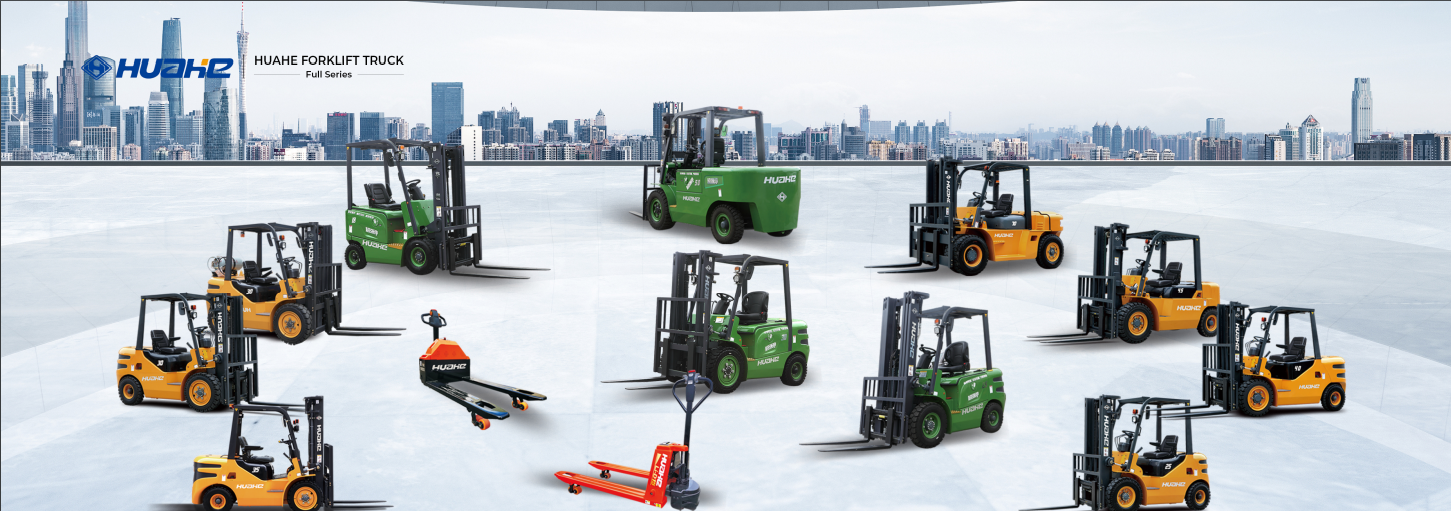
Huahe specializes in manufacturing 1-10 ton forklifts, including Lithium Battery Forklifts, Diesel Forklifts, and LPG Forklifts, covering three series to meet your various material handling needs.
We sincerely invite global distributors and agents to join ! Obtain exclusive regional agency policies!
(Check the product parameters and specifications of the forklift on the right)
FAQ
Q1: Is the HH702 suitable for outdoor use?
A1: Yes, with its diesel engine, high ground clearance, and all-terrain tires, it is ideal for outdoor and rough terrain applications.
Q2: How to choose between the two engines?
A2: ISUZU 6BG1 offers higher torque (411 N·m) for heavy loads, while Xichai CA6110 provides higher power (85 kW) for speed and fuel efficiency.
Q3: Does the forklift comply with emission standards?
A3: Both engines meet Chinese non-road diesel emission standards. Please contact local dealers for specific emission levels.
Q4: Can I customize forks or attachments?
A4: Yes, a variety of attachments such as side shifters and rotators are available upon request.

