
Please Choose Your Language


Views: 0 Author: Site Editor Publish Time: 2026-07-31 Origin: Site


Purchasing a cleaning system based on a single metric often leads to major operational problems. You might experience inefficient cleaning routines, severely damaged surfaces, or entirely wasted capital. Buyers frequently over-index on PSI because manufacturers heavily market this specific number. However, evaluating the actual relationship between PSI and GPM remains the only reliable way to predict real-world cleaning efficiency. Focusing purely on pressure ignores the vital role water volume plays in your daily workflow.
Today, we will clearly define both of these crucial metrics for you. We will introduce the industry-standard performance formula to help you measure actual output. Finally, you will learn a practical framework for selecting the exact specifications required for your specific operational needs. Understanding this balance ensures you deploy the right tool for every unique environment.
PSI (Pounds per Square Inch) determines the stripping power—how effectively the water breaks the bond between dirt and a surface.
GPM (Gallons per Minute) determines the flushing power—how fast the volume of water washes the loosened debris away.
Cleaning Speed: Higher GPM translates directly to faster cleaning times and reduced labor costs.
Evaluation Metric: Multiplying PSI by GPM yields Cleaning Units (CU), a more accurate baseline for comparing equipment performance.
Infrastructure Reality: Your machine’s true GPM is strictly limited by your facility's or site's water supply flow rate.
Operators must understand how pressure and flow work together to achieve optimal results. Each metric performs a highly specific job during the wash cycle. You cannot substitute one for the other.
PSI stands for Pounds per Square Inch. It represents the physical force pushing the water out of the nozzle. You can think of it as stripping power. High pressure breaks the chemical and physical bonds holding contaminants to a surface. When you tackle baked-on grease, hardened chewing gum, or peeling paint, you rely heavily on PSI. It penetrates the stubborn layers and detaches them from the substrate.
However, excessive force brings severe risks. Operators often push pressure limits assuming higher numbers always yield better results. This misconception ruins materials. Applying massive PSI without using appropriate nozzles causes irreversible surface damage. You might etch permanent lines into concrete driveways. You could easily splinter wooden decks or strip clear coats off vehicles. Force must always match the durability of the target material.
GPM stands for Gallons per Minute. It measures the total volume of water flowing through the system. We consider this your flushing power. Once the pressure breaks the dirt loose, the water volume acts as a carrier. It sweeps the broken-down contaminants away from the work zone.
GPM dictates the overall pace of the job. It directly impacts your operational outcome. For wide-area tasks, water volume matters far more than pressure. Moving from a 2.0 GPM machine to a 4.0 GPM system effectively cuts your cleaning time in half. The heavy flow acts like a large liquid broom. Every operator using a standard pressure washer realizes quickly how low GPM merely pushes mud around. High GPM actually removes it from the surface entirely.
Looking at individual numbers rarely tells the whole story. The industry relies on a specific formula to evaluate overall machine capability. This framework levels the playing field when you compare different equipment brands.
You calculate true performance using a simple equation: PSI × GPM = Cleaning Units (CU). This formula combines force and flow into one unified metric. CU provides a standardized lens for procurement teams. It removes the marketing fluff from spec sheets.
Imagine comparing two distinct machines on a showroom floor. Machine A offers 4000 PSI and 2 GPM. Machine B offers 2000 PSI and 4 GPM. Both systems generate exactly 8,000 CU. However, they serve entirely different operational purposes.
Machine A excels at highly concentrated, slow-paced stripping tasks. Machine B excels at rapidly rinsing large surface areas. Using CU helps you verify the total energy output. You then adjust the ratio of pressure to flow based on your daily tasks.
Standard Machine Configuration Comparison
Machine Type | PSI Rating | GPM Rating | Total CU | Best Application |
|---|---|---|---|---|
High-Pressure Unit | 4000 | 2.0 | 8,000 | Paint stripping, rust removal |
High-Flow Unit | 2000 | 4.0 | 8,000 | Fleet washing, large flatwork |
Balanced Unit | 3000 | 3.0 | 9,000 | General property maintenance |
While CU serves as a fantastic baseline, it is not the only metric you should evaluate. High CU scores mean nothing if the internal components fail after one season. Pump quality heavily dictates actual commercial value. Continuous-duty ratings tell you if the machine can run all day without overheating. Additionally, heating elements completely change the dynamic. Hot water melts grease at lower PSI levels, making cold-water CU comparisons slightly irrelevant for oily environments. Always look beyond the primary numbers.
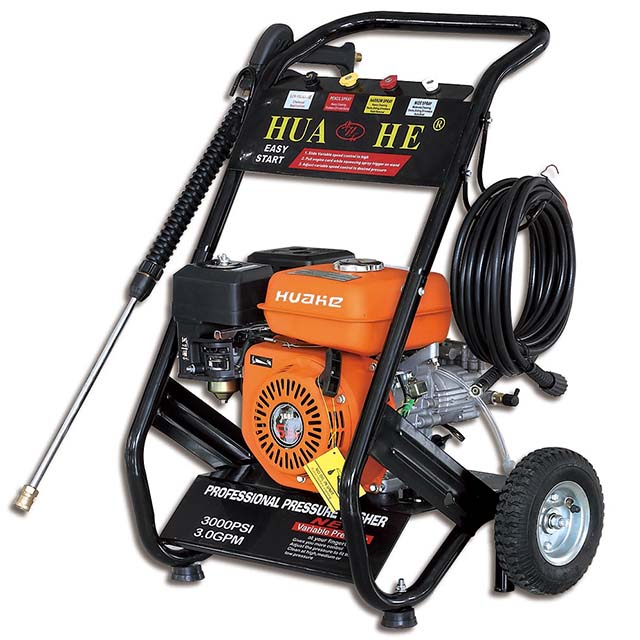
Selecting the right specifications requires evaluating your primary daily tasks. You must build a decision matrix based on the contaminants you face most frequently. We break these down into three distinct scenarios.
You need massive force when dealing with stubborn, bonded contaminants. These materials cling tightly to the substrate. Low pressure will just wash right over them without causing detachment.
Applications: Paint stripping, graffiti removal, heavy machinery degreasing, and rust scale removal.
Ideal Specs: You generally need 3000+ PSI. In industrial settings, some tasks require 4000 to 5000 PSI to fracture the chemical bonds.
Operational Note: Keep your GPM moderate here. Too much flow combined with extreme pressure creates dangerous kickback for the operator.
Volume becomes your top priority when focusing on surface area rather than bonded dirt. In these situations, the dirt usually breaks free easily. You just need to move it away quickly.
Applications: Large fleet washing, cleaning agriculture equipment, rinsing mud off wide concrete pads, and washing delicate siding.
Ideal Specs: Target 4.0 to 8.0+ GPM.
Operational Note: Massive flow allows operators to use wider spray patterns. You cover more ground per pass without losing your flushing ability. It speeds up the rinsing phase dramatically.
Many contractors face unpredictable daily schedules. You might clean a concrete driveway in the morning and wash vinyl siding in the afternoon. Versatility becomes your most valuable asset.
Applications: Standard commercial cleaning and general property maintenance.
Ideal Specs: Usually 3000 to 3500 PSI paired with 3.0 to 4.0 GPM.
Operational Note: This balance allows you to dial down pressure using specific nozzles while maintaining enough flow to work efficiently.
Commercial growth eventually forces you to upgrade your equipment. Small consumer systems cannot survive the rigorous demands of professional use. You must understand the structural differences before investing.
Consumer units feature lightweight wobble or axial cam pumps. Manufacturers design them for roughly 50 hours of annual use. They work perfectly for occasional weekend chores. Conversely, an industrial high pressure washer utilizes robust triplex plunger pumps. Engineers build these specific machines for continuous, daily operation. They run for thousands of hours when maintained properly. They feature thicker brass manifolds and ceramic plungers to withstand constant heat and friction.
Buying complex equipment off a retail shelf limits your capabilities. Engaging directly with a high pressure washer manufacturer or a specialized distributor remains critical for complex setups. They customize the build to match your exact water supply and operational goals. They also provide crucial technical support and readily available replacement parts. Retail stores rarely stock the specialized seals and unloader valves required to keep heavy-duty machines running.
Industrial applications often require permanent installations. You must choose between stationary plant builds and mobile trailer systems. Mobile units require integrated water tanks to feed high-flow pumps.
You also need to evaluate pump drive types. Direct-drive pumps attach directly to the engine shaft. They spin at high RPMs, which generates excess heat. Belt-drive systems use pulleys to connect the engine to the pump. Belt drives run at much lower RPMs. They pull water from stationary tanks more efficiently. This lower operating speed dramatically extends pump life during high-GPM industrial use.
Even experienced buyers fall into specific technical traps. Misunderstanding how these machines actually operate in the field leads to catastrophic equipment failure. Watch out for these three major pitfalls.
Consumer-grade brands frequently manipulate their numbers. They artificially inflate PSI ratings to attract buyers. They achieve these high numbers using pinpoint zero-degree nozzles under closed-valve testing conditions. They measure the absolute maximum spike in pressure rather than the operational working pressure. Always check the technical data sheet for "working PSI." This number reflects the actual force you receive during a continuous spray.
Your machine's flow rating relies entirely on your water source. Running a 5 GPM system on a municipal spigot that only outputs 3 GPM creates a massive problem. You will starve the pump of water. This creates vacuum bubbles inside the pump chamber. When these bubbles collapse under pressure, they blast microscopic chunks of metal out of the brass manifold. We call this cavitation. It leads to catastrophic pump failure in minutes.
Always test your site before turning the machine on. Use this simple bucket test:
Grab a standard 5-gallon bucket.
Turn the supply spigot on to its maximum flow.
Place the bucket under the water and start a stopwatch.
Stop the timer after exactly one minute.
Check the water level. If it sits below your machine's GPM rating, you cannot run that equipment without an external buffer tank.
Your pump generates flow, but the nozzle creates the pressure. Using the wrong orifice size on a nozzle alters both outputs completely. If you place a large-orifice nozzle on a small machine, pressure drops drastically. If you place a tiny-orifice nozzle on a high-flow machine, back pressure spikes. This forces the unloader valve into bypass mode, rendering your baseline machine specs completely irrelevant. You must match the nozzle size perfectly to your machine's specific GPM and PSI.
Evaluating cleaning equipment requires a systematic approach rather than guesswork. You must look past the flashy stickers on the box to understand true mechanical capabilities. Follow a strict evaluation hierarchy to ensure success.
First, measure your available water supply. Your facility's flow rate permanently dictates the maximum GPM machine you can safely operate.
Second, identify the primary contaminant you fight daily. This directly dictates the PSI needed to break surface bonds.
Third, maximize your GPM within your budget constraints. Higher flow guarantees immense labor efficiency and faster job completion.
Your next steps are clear. Calculate the required Cleaning Units for your specific tasks. Consult official technical data sheets for working metrics rather than relying on box-store packaging claims. Selecting the precise balance of force and volume keeps your operators safe, protects vulnerable surfaces, and ensures your equipment survives the daily grind.
A: No. Higher PSI introduces significant surface damage risks. Excessive force will etch concrete, splinter wood, and destroy vehicle clear coats. Once you have enough pressure to break the dirt bond, adding more PSI offers diminishing returns. You should focus on increasing water volume instead for better cleaning efficiency.
A: Yes. The nozzle opening, called the orifice, restricts water flow to create pressure. If you attach a nozzle with a larger orifice, the water escapes more easily. This reduces the back pressure in the hose and manifold, which ultimately lowers your working PSI.
A: No. GPM is a fixed mechanical rating determined by the physical size of the pump's plungers and the engine's RPMs. You cannot increase it beyond the factory specification. While you can slightly regulate PSI downward using different nozzles, maximum flow rate remains completely locked by the hardware.
A: Auto detailing requires a high GPM and low PSI balance. You generally want to stay under 1500 to 2000 PSI to protect clear coats, plastics, and rubber trim. Pairing this low pressure with a higher flow rate (2.0 to 3.0 GPM) provides excellent flushing power to safely rinse heavy soap and road grime.
