
Please Choose Your Language


Views: 0 Author: Site Editor Publish Time: 2026-08-16 Origin: Site


Buying the wrong equipment to wash your vehicle triggers a common fear among car owners. You worry about purchasing a machine too weak to lift stubborn road grime. Alternatively, you might buy one so aggressive it strips your expensive clear coat. It could even destroy delicate plastic exterior trim. Marketing campaigns heavily push maximum pressure as the ultimate selling point for consumers. However, safe auto detailing requires a high flow rate rather than sheer, destructive force. You need adequate water volume to safely encapsulate and rinse away abrasive dirt. The right pressure washer balances specific output metrics alongside highly durable hardware. It must also feature universal accessory compatibility. This ensures you get a safe, efficient, and deeply satisfying washing experience every time you step into the driveway. In this comprehensive guide, you will learn how to decode confusing technical specifications. We will show you exactly what to look for when evaluating pumps, power sources, and essential detailing accessories.
Ideal Specs: The sweet spot for car paint is 1,000–1,500 PSI and 1.5–2.0 GPM.
Power Source: Electric models are overwhelmingly preferred for automotive detailing due to consistent, safe power delivery and low noise.
Hardware Matters: Look for universal 1/4-inch quick-disconnect fittings; proprietary hoses and wands severely limit aftermarket upgrades.
Pump Longevity: Triplex pumps offer long-term durability for frequent users, while standard axial pumps suit occasional weekend washers.
Big box stores train consumers to look at a single number on the retail box. They promote massive pressure figures to signal superior cleaning power. For automotive applications, this mindset leads directly to expensive paint correction bills.
A machine blasting 3,000+ PSI presents a massive liability for automotive finishes. Modern car paint consists of a thin base color layer protected by a fragile clear coat. Extreme pressure easily pierces this clear coat. It acts like a water scalpel. High-velocity streams force water beneath protective clear bra films (PPF). They shred vinyl decals instantly. Extreme pressure also forces moisture past rubber window seals. This floods interior cabin spaces. You never need construction-grade blasting power to remove loose dirt from a vehicle bumper.
Professional detailers rely on a specific performance window to guarantee paint safety while maximizing washing efficiency.
PSI (Pounds per Square Inch): Keep your output between 1,000 and 1,500 PSI. This provides enough agitation to dislodge traffic film securely. It never risks burning through delicate topcoats.
GPM (Gallons per Minute): Aim for 1.5 to 2.0+ GPM. High water volume provides vital lubrication. It safely carries abrasive dirt particles off the panel. High flow also rinses away thick snow foam much faster than low-flow machines.
You need a better baseline metric than PSI alone. Industry experts use a simple formula called Cleaning Units (CU). You calculate this by multiplying PSI by GPM. A machine pushing 1,000 PSI at 2.0 GPM delivers 2,000 CU. A different unit pushing 2,000 PSI at 1.0 GPM also delivers 2,000 CU. The first machine cleans cars safely and efficiently. The second machine risks paint damage while taking twice as long to rinse away soap.
Cleaning Units Comparison Chart
Machine Type | PSI | GPM | Cleaning Units (CU) | Automotive Safety Rating |
|---|---|---|---|---|
Budget Electric | 1,800 | 1.1 | 1,980 | Moderate (Low flow hinders rinsing) |
Detailer Electric | 1,100 | 2.0 | 2,200 | Excellent (High lubrication, safe pressure) |
Commercial Gas | 3,200 | 2.5 | 8,000 | Dangerous (Requires pressure reduction) |
Your primary power source dictates how you interact with your washing setup daily. Each category serves vastly different environments and user requirements.
Electric models dominate the car care industry for excellent reasons. They offer consistent, paint-safe pressure right out of the box.
Pros: They require virtually zero engine maintenance. You never worry about changing oil or storing stale gasoline. Electric motors run significantly quieter. They only produce noise when you pull the trigger. You can safely mount them indoors or inside enclosed detailing garages without carbon monoxide risks.
Cons: You remain tethered to an electrical outlet. Cheap extension cords cause voltage drops, burning out the motor. Powerful electric models pull 13 to 15 amps. They easily trip household circuit breakers unless plugged into a dedicated 15-amp or 20-amp circuit.
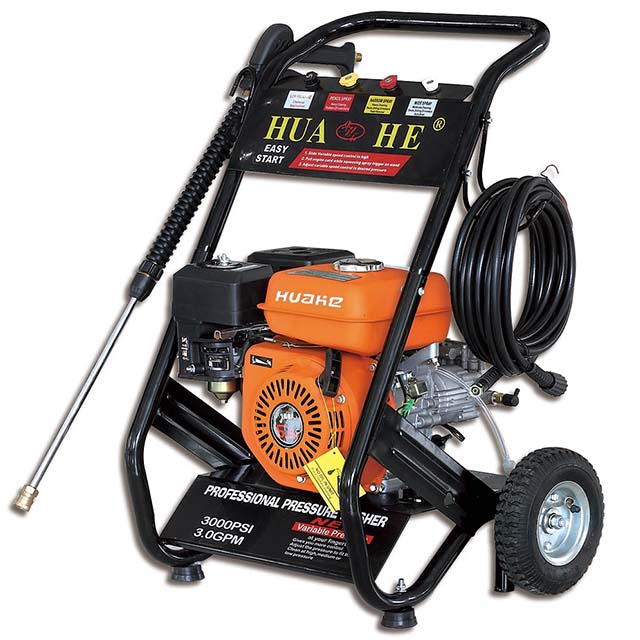
Gasoline engines provide unmatched mobility. They deliver massive water flow capabilities. However, they introduce severe risks for passenger vehicles.
Use Case: These are strictly built for mobile detailing rigs lacking grid power access. They also excel at heavy-duty fleet washing or commercial truck cleaning. An industrial high pressure washer handles continuous, all-day operation without overheating.
Risks: Stock gas machines push well over 2,500 PSI. You must throttle down this pressure before pointing the wand at a car. Detailers achieve this by installing larger orifice nozzles (like a size 4.0 or 5.0 tip). This drops the operating PSI into the safe 1,000–1,500 range while maintaining the engine's massive GPM output.
The motor simply spins the internal mechanics. The pump actually does the heavy lifting. Pump quality ultimately determines how many years your investment survives.
Consumers usually face a choice between two primary pump designs. Understanding their internal architecture prevents expensive replacement cycles.
Wobble/Axial Cam Pumps: Manufacturers install these in budget-friendly consumer units. A spinning plate pushes pistons back and forth. They generate significant internal friction. These pumps come completely sealed from the factory. They are entirely non-serviceable. Expect a total lifespan ranging from 100 to 300 hours. They work perfectly fine for casual users washing one car every other weekend.
Triplex Plunger Pumps: These represent the gold standard for prosumer and commercial setups. They run off a crankshaft mechanism. They operate much smoother and run substantially cooler. You can easily service triplex pumps. You change the oil and replace worn seals. This architecture delivers a significantly longer lifespan, often exceeding 1,000 working hours.
Budget box-store machines suffer from one critical flaw. They utilize proprietary hoses, unique wands, and customized gun connections. Brands do this intentionally. They force you to buy their specific branded replacement parts. When a cheap plastic wand cracks, you cannot simply buy a better aftermarket alternative.
Always demand standard M22-14mm threaded connections. Look for universal 1/4-inch quick disconnects (QD) at the gun nozzle. Standardized fittings allow you to upgrade your foam cannon, attach swivel joints, or buy flexible aftermarket hoses without fighting frustrating adapters.
Before purchasing, heavily scrutinize the high pressure washer manufacturer. Evaluate their warranty terms carefully. Read the fine print to see if they cover both the electric motor and the pump assembly equally. Check their website for easily accessible replacement parts. If you cannot easily order basic o-rings or a replacement unloader valve, choose a different brand.
The machine only provides the water source. The accessories you attach to it dictate your actual detailing experience. Upgrading stock accessories transforms a frustrating chore into a seamless process.
Your nozzle dictates the spray pattern and the striking force. Incorrect nozzle choices ruin paint jobs instantly.
Avoid the 0-degree (red) and 15-degree (yellow) tips entirely. The red tip acts like a laser beam, meant only for stripping tough concrete stains. The yellow tip still concentrates too much force for delicate clear coats.
Mandate the use of 25-degree (green) or 40-degree (white) nozzles. These create paint-safe, wide fan sprays. They distribute water pressure evenly across a larger surface area. This wider footprint sweeps dirt off the panel highly efficiently.
Manufacturers often cut costs by including terrible stock hoses. These cheap plastic hoses feel notoriously stiff. They coil up violently. They constantly fight you while you walk around the vehicle. Worse, their hard plastic exterior easily mars and scratches car paint if they rub against the fender.
Evaluate machines based on their ability to accept aftermarket hose upgrades. You want a kink-resistant, non-marring rubber hose. Polyurethane hoses also offer incredible flexibility. A highly flexible hose dramatically improves your user experience.
A thick layer of snow foam lubricates the paint before you touch it with a wash mitt. However, foam thickness relies entirely on water volume. Explain this simple rule to anyone building a setup: minimum GPM dictates foam quality. You generally need at least 1.2 GPM to produce shaving-cream-like lather. If your machine only pushes 1.0 GPM, your foam will always look watery and run off the paint too quickly, regardless of the soap brand.
Choosing the perfect unit means aligning the hardware capabilities with your personal usage habits and budget constraints.
You wash your car once or twice a month. You want something simple. Priorities include compact storage, a lightweight electric motor, and basic foam cannon capability. You accept a sealed wobble pump. You expect to replace the entire unit every three to five years. Look for a unit hitting 1.2 GPM to ensure adequate soap foaming.
You wash multiple cars every week. You demand reliability and a seamless workflow. Priorities include an induction motor for quieter operation. You require replaceable standard M22 fittings. This allows an aftermarket stubby gun upgrade path. A stubby gun removes the long, clumsy stock wand. It makes washing tight wheel wells vastly easier. You will spend extra money upfront for a machine pushing 1.8 to 2.0 GPM.
You run a professional detailing business out of a van. You need serious durability. Priorities include a dedicated high pressure washer capable of running heavily all day. You choose between a customized gas engine setup or a high-amp battery-bank-powered electric unit. You demand a heavy-duty triplex pump. You also require external bypass routing to prevent the pump from overheating while you step away to scrub tires.
Choosing a safe, effective washer for a vehicle always revolves around controlling water flow. You must prioritize GPM rather than blindly chasing peak PSI force. A highly controlled, high-volume spray lifts dirt safely without jeopardizing your vehicle's delicate clear coat. Remember to factor aftermarket accessories into your total budget before pulling the trigger. Calculate your actual usage frequency first. If you wash weekly, invest in a prosumer electric model featuring standard fittings. Always allocate extra funds for mandatory upgrades like a kink-resistant rubber hose and a high-quality short gun. These specific upgrades guarantee a superior, paint-safe washing experience for years to come.
A: Yes, if using a 0-degree nozzle or exceeding 2,000 PSI too close to the panel. Maintain a safe distance of 12–18 inches away from the paint surface at all times to prevent clear coat failure.
A: No. Thick foam relies primarily on a quality foam cannon, the correct chemical soap ratio, and a consistent flow rate of around 1.5 to 2.0 GPM. Massive engine power is unnecessary for foaming.
A: Surging is usually caused by a strict water supply restriction. It also happens if you have an air leak in your garden hose connection or a partially clogged spray nozzle tip.
A: Pre-packaged kits offer excellent convenience for beginners. However, building a custom setup by purchasing a bare unit and adding a high-quality aftermarket hose and stubby gun often yields better long-term durability and usability.
