
Please Choose Your Language


Views: 0 Author: Site Editor Publish Time: 2026-04-22 Origin: Site


Yes, you can and must turn off a diesel forklift. Doing so incorrectly—or failing to do so during downtime—creates significant mechanical and financial liabilities. Leaving an engine running might seem harmless, but it quietly drains your bottom line.
For fleet managers and operators, the daily decision of when and how to shut down equipment directly impacts your Total Cost of Ownership (TCO). This choice affects everything from starter motor lifespan to Diesel Particulate Filter (DPF) maintenance and workplace safety compliance. Managers must balance fuel economy against the wear and tear of constant restarting.
This guide breaks down the strict financial trade-offs between idling and shutting down. We outline standard compliance procedures and detail the essential cooldown phases required for heavy machinery. Finally, you will learn specific troubleshooting frameworks for engines that fail to stop.
TCO Trade-off: Shutting down a diesel forklift prevents expensive DPF clogging and "wet stacking," but doing it too frequently accelerates starter motor and battery wear.
The 3-Minute Rule: Industry baseline dictates shutting off the engine if the forklift will be inactive for more than 3 to 5 minutes to optimize fuel and maintenance costs.
Turbo Cooldown is Non-Negotiable: Immediate shutdown after heavy loads risks turbocharger failure; a 1-2 minute idle cooldown is required.
Emergency Frameworks: An engine that refuses to shut down (due to solenoid failure or "diesel runaway") requires immediate, specific interventions like air-intake starvation to prevent catastrophic failure.
Operators frequently debate whether to leave an engine running during short breaks or power it down. We frame this business problem around a simple balance. You must weigh fuel consumption and emissions compliance against the mechanical wear of constant restarting.
Idling feels harmless, yet it silently inflates operational costs. The most obvious penalty is fuel waste. Quantifiable fuel burn during idle periods degrades shift efficiency and inflates your daily operating budget. Even at low RPMs, a diesel forklift consumes a measurable amount of fuel per hour. Over a large fleet, this waste compounds into thousands of dollars annually.
Beyond fuel, idling introduces severe DPF and wet stacking risks. Diesel engines require high operating temperatures to burn fuel efficiently. Extended idling prevents the exhaust from reaching necessary regeneration temperatures. This leads to premature DPF clogging. Furthermore, cold cylinders cannot fully combust injected fuel. This unburned fuel washes lubricating oil off the cylinder walls and pools in the exhaust system. We call this phenomenon wet stacking, and it drastically reduces engine life.
Conversely, shutting down too frequently carries its own mechanical penalties. Diesel engines require massive electrical current to turn over. Constant restarting causes accelerated wear on the starter motor, the ignition switch, and the entire battery matrix. Replacing a burned-out heavy-duty starter motor often costs more than the fuel saved by micro-managing engine shutdowns.
To optimize your fleet ROI, adopt a standardized operational framework. Do not leave the decision up to individual operator preference.
Short pauses (under 3 minutes): Maintain idle to save starter components.
Extended pauses (over 3-5 minutes, shift changes, or indoor use): Mandatory shutdown to preserve air quality and reduce fuel and DPF costs.
Operational Scenario | Fuel & Emissions Impact | Mechanical Wear Impact | Recommended Action |
|---|---|---|---|
Pause < 3 Minutes | Low fuel waste; minimal emission buildup. | High starter/battery strain if shut down. | Keep Engine Running |
Pause 3 – 5 Minutes | Moderate fuel waste; DPF temps begin dropping. | Moderate starter wear justified by fuel savings. | Operator Discretion / Site Policy |
Pause > 5 Minutes | High fuel waste; severe wet stacking risk. | Negligible starter impact relative to savings. | Mandatory Shutdown |
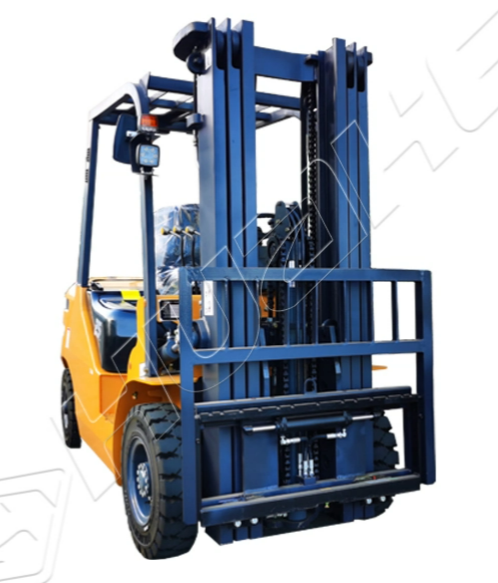
Proper shutdown is a critical compliance and safety habit. It is never just a simple turn of the key. Implementation realities dictate that operators must follow strict sequences to protect themselves, bystanders, and the equipment.
Enforce the following standard operating procedure across all shifts. Skipping these steps invites hydraulic failure, localized accidents, or severe engine damage.
Secure the Load: Lower the forks completely to the ground. Tilt the mast slightly forward so the fork tips touch the floor. This relieves hydraulic pressure in the lift cylinders and prevents the carriage from drifting downward while unattended.
Neutral & Brake: Shift the transmission into neutral. Engage the parking brake firmly. This guarantees the forklift remains stationary, even if parked on a slight incline.
The Cooldown Phase (Crucial): Allow the engine to idle for 1 to 2 minutes if it has been operating under heavy load. The mechanical reality behind this step is undeniable. Turbochargers spin at incredibly high speeds and generate extreme heat. Idling circulates cooler oil through the turbo bearings. If you shut down instantly, oil flow stops. The residual heat literally bakes the stationary oil into hard carbon deposits—a process called oil coking. Over time, coking destroys turbo bearings.
Power Down: Turn the ignition key to the off position. Remove the key entirely to prevent unauthorized use. Store the key in its designated secure location.
Best Practices for Cooldowns
Train operators to use the time spent lowering the forks and filling out shift paperwork as their designated turbo cooldown window. This integrates the delay naturally into their workflow, increasing compliance without feeling like wasted time.
Few situations cause as much operator panic as a machine that refuses to stop. An ignition key that turns to the "off" position but leaves the engine running indicates a mechanical or electrical failure. This immediately halts productivity and introduces severe operational risk.
Diesel engines do not rely on spark plugs. They run on compression ignition. As long as the engine receives air and fuel, it will continue to run. Therefore, shutdown failures almost always relate to fuel delivery systems.
Fuel Shutoff Solenoid Failure: This is the most common culprit. The shutoff solenoid is an electromagnetic valve. It requires electrical power to stay open. When you turn the key off, power drops, and a spring snaps the valve shut, cutting off fuel. If the solenoid jams due to debris, or if the return spring breaks, the valve fails to close. Fuel continues reaching the injectors.
Ignition Switch/Wiring Faults: Sometimes the solenoid works perfectly, but broken circuits prevent the "stop" signal from reaching it. Corroded wiring, a faulty ignition cylinder, or a bad relay can essentially trap the system in an energized state.
If you encounter a refusal to shut down, operators must know how to cut the engine manually. You cannot simply disconnect the battery. Because diesels lack an electrical spark system, removing the battery will not stop a running engine and will likely destroy the alternator.
Instead, locate the manual shutoff lever. Many fuel injection pumps feature a mechanical override lever near the priming pump or solenoid. Pushing this lever physically blocks the fuel rack, starving the engine. If you cannot locate the lever, pinching the flexible rubber fuel supply line serves as a last-resort mechanical intervention. Doing so cuts off the diesel supply, though it may introduce air into the system requiring bleeding later.
Once you stop the engine, tag out the forklift immediately. Operating any heavy machinery with a faulty shutdown mechanism violates fundamental safety compliance. The equipment must remain sidelined until a qualified technician replaces the faulty solenoid or repairs the wiring harness.
While a failed solenoid is a nuisance, a "diesel runaway" is a profound emergency. Defining the threat is crucial for workplace safety. A runaway is a rare but catastrophic scenario where a diesel engine ingests an unintended fuel source and revs uncontrollably past its redline, entirely ignoring the ignition switch.
Usually, this unintended fuel is the engine's own lubricating oil. If internal turbocharger seals blow, pressurized engine oil sprays directly into the air intake. The engine combusts this oil just like diesel fuel. As RPMs rise, the engine pumps oil faster, creating a terrifying feedback loop. Left unchecked, the engine will accelerate until internal components melt or connecting rods explode through the engine block.
Your absolute first priority is human life. Evacuate non-essential personnel immediately. A runaway engine carries a high risk of explosive mechanical failure. Shrapnel from a disintegrated flywheel or engine block can be lethal.
Because the engine is consuming its own crankcase oil, cutting the standard diesel fuel line will not stop a runaway engine. You must eliminate its air supply.
Air Starvation (Primary method): You must block the main air intake. Use a solid, flat object like a clipboard, a thick piece of wood, or a heavy plastic board to cap the intake pipe. Never use your hand or a rag. The extreme vacuum force will suck a rag directly into the intake, destroying it instantly and failing to stop the engine. It will severely injure a human hand.
CO2 Fire Extinguisher: If you cannot safely cap the intake, discharge a CO2 fire extinguisher directly into the air intake stream. The CO2 displaces atmospheric oxygen, effectively suffocating the engine. Do not use dry chemical extinguishers unless absolutely necessary, as the powder will destroy the engine's internal cylinders.
Note: Only attempt these interventions if you can do so safely. If the engine is already screaming near structural failure, abandon the machine and clear the area.
Relying on manual compliance for cooldowns and idle limits often yields mixed results. Solution categories for modern fleet buyers focus heavily on moving from manual enforcement to automated compliance.
Modern equipment increasingly features programmable control modules. Auto-shutdown technologies translate directly from features to financial outcomes. These systems utilize programmable timers that automatically kill the engine after a set period—usually 3 to 5 minutes—of seat switch inactivity.
The ROI drivers for these systems are compelling. They provide a guaranteed reduction in idle fuel consumption. Furthermore, by preventing hour after hour of low-temperature idling, they prolong DPF regeneration intervals and protect the turbocharger from extended wet stacking.
Advanced fleet management requires data. Telemetry integration allows managers to pull CAN bus data directly from the equipment. You can track exact idle hours versus working operating hours. This ratio helps optimize planned maintenance schedules.
If an engine runs for 1,000 hours, but telemetry reveals 400 of those were idle hours, your oil degradation and DPF soot loads differ vastly from an engine working hard for 900 hours. Telemetry allows you to pivot from calendar-based maintenance to condition-based maintenance.
Feature | Primary Benefit | Secondary Benefit | Payback Period Estimate |
|---|---|---|---|
Seat-Switch Timer | Eliminates shift-change idling waste | Reduces cabin vibration exposure | 6 - 8 Months |
Idle Telemetry Tracker | Identifies operators needing SOP retraining | Improves maintenance scheduling accuracy | 10 - 12 Months |
Automated Cooldown Delay | Protects turbocharger bearings automatically | Removes operator guesswork | Immediate (avoids $3k+ failure) |
Shortlisting logic dictates that when purchasing or leasing new equipment, you must prioritize OEM or aftermarket systems that offer customizable idle-timer parameters. Buying a machine without telemetry today limits your financial control tomorrow.
Turning off a diesel forklift correctly bridges the gap between basic operator safety and advanced fleet cost control. It is not merely a matter of turning a key; it is an active mechanical strategy. Managers who mandate strict cooldown phases and limit idle times see immediate reductions in maintenance overhead.
Enforcing proper cooldown protocols and minimizing idle time directly extends the lifecycle of high-ticket engine components. DPFs stay cleaner, turbos survive longer, and starter motors remain intact.
Audit Current Habits: Spend time on the warehouse floor observing how your operators currently handle shift changes and heavy-load shutdowns.
Standardize the Rule: Implement a strict 3-minute idle rule and a mandatory 2-minute turbo cooldown phase across the entire organization.
Evaluate Upgrades: Calculate the ROI of installing aftermarket auto-shutdown timers on your existing fleet assets to automate your fuel savings.
A: Aim for 1 to 2 minutes of idling after heavy use. This dedicated cooldown window allows the turbocharger to decrease in speed and cool down safely. It ensures engine oil continues circulating, which prevents extreme heat from baking the stationary oil into hard carbon deposits inside the turbo bearings.
A: Yes, if done excessively for short stops under 2 minutes. Starters draw massive amperage and wear out quickly under rapid cycling. However, for stops longer than 3 to 5 minutes, the long-term fuel savings and the protection of the DPF system completely outweigh the cost of starter wear.
A: No. Diesel engines rely on high-pressure compression ignition, not an electrical spark system. Once running, they power their own fuel delivery. Disconnecting the battery will not stop the engine from running and doing so will likely cause severe, permanent damage to the vehicle's alternator.
